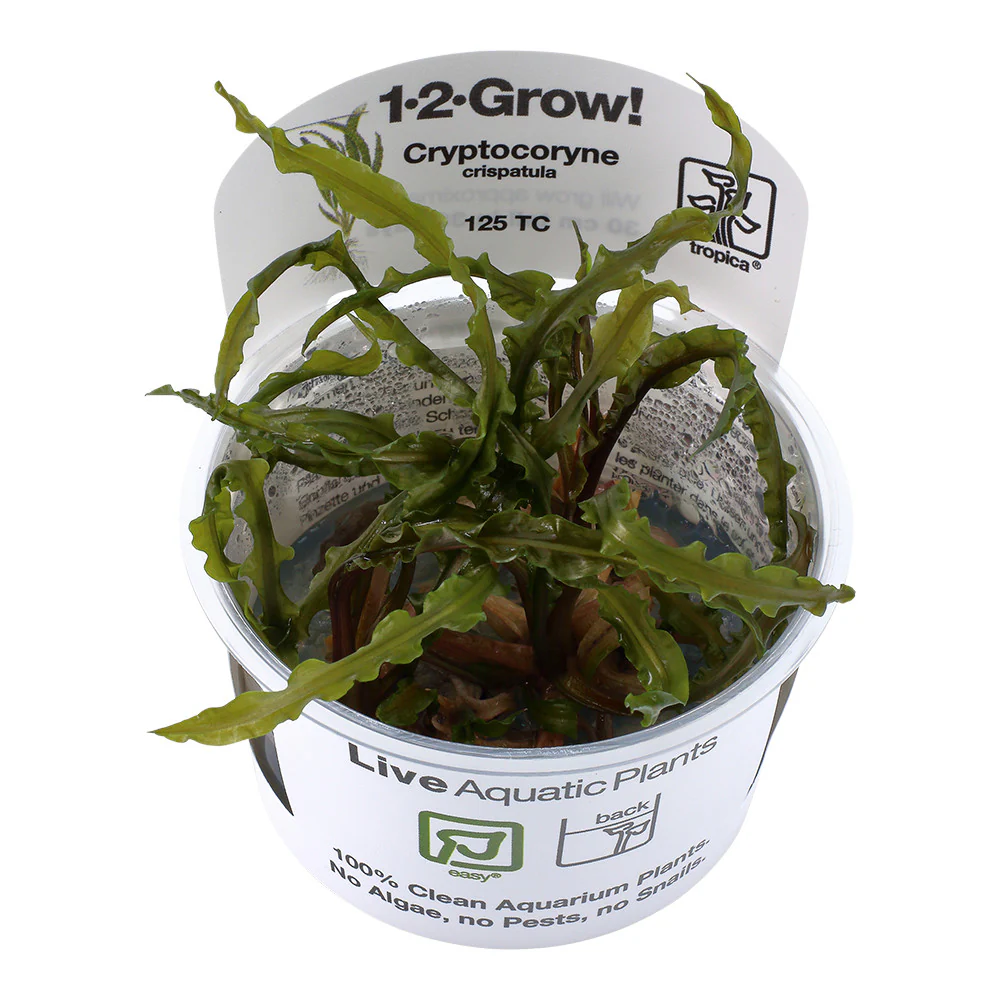
Dennerle Cryptocoryne wendtii 'Mi Oya' Plant-It
Aquarium plant from tissue culture in closed cup.
This beautiful variety of Cryptocoryne wendtii is only found in the river Mi Oya in Sri Lanka. It has characteristic red-brown, slightly hammered leaves from 20-35 cm, and 15-30 cm wide rosettes. Many Cryptocorynes can grow at high temperatures. In the wild, this plant is found in streams with a temperature of more than 30 degrees C.
Plant info
| Type: | Rosulate | |
|---|---|---|
| Origin: | Asia | |
| Growth rate: | Slow | |
| Height: | 20 - 30+ | |
| Light demand: | Low | |
| CO2 : | Low |
All Dennerle Plant-It! In-Vitro plants are cultivated under sterile conditions. This ensures that there are no pest infestations or pathogens present. Additionally, there are no algae, snails, or snail eggs. These are very compact, highly branched plants. The submerged habit eliminates the changeover phase from emersed to submerged in the aquarium.
Product Information
Product Information
Shipping & Returns
Shipping & Returns


Dennerle Cryptocoryne wendtii 'Mi Oya' Plant-It
Dennerle Cryptocoryne wendtii 'Mi Oya' Plant-It
Aquarium plant from tissue culture in closed cup.
This beautiful variety of Cryptocoryne wendtii is only found in the river Mi Oya in Sri Lanka. It has characteristic red-brown, slightly hammered leaves from 20-35 cm, and 15-30 cm wide rosettes. Many Cryptocorynes can grow at high temperatures. In the wild, this plant is found in streams with a temperature of more than 30 degrees C.
Plant info
| Type: | Rosulate | |
|---|---|---|
| Origin: | Asia | |
| Growth rate: | Slow | |
| Height: | 20 - 30+ | |
| Light demand: | Low | |
| CO2 : | Low |
All Dennerle Plant-It! In-Vitro plants are cultivated under sterile conditions. This ensures that there are no pest infestations or pathogens present. Additionally, there are no algae, snails, or snail eggs. These are very compact, highly branched plants. The submerged habit eliminates the changeover phase from emersed to submerged in the aquarium.
Original: $7.99
-70%$7.99
$2.40Product Information
Product Information
Shipping & Returns
Shipping & Returns
Description
Aquarium plant from tissue culture in closed cup.
This beautiful variety of Cryptocoryne wendtii is only found in the river Mi Oya in Sri Lanka. It has characteristic red-brown, slightly hammered leaves from 20-35 cm, and 15-30 cm wide rosettes. Many Cryptocorynes can grow at high temperatures. In the wild, this plant is found in streams with a temperature of more than 30 degrees C.
Plant info
| Type: | Rosulate | |
|---|---|---|
| Origin: | Asia | |
| Growth rate: | Slow | |
| Height: | 20 - 30+ | |
| Light demand: | Low | |
| CO2 : | Low |
All Dennerle Plant-It! In-Vitro plants are cultivated under sterile conditions. This ensures that there are no pest infestations or pathogens present. Additionally, there are no algae, snails, or snail eggs. These are very compact, highly branched plants. The submerged habit eliminates the changeover phase from emersed to submerged in the aquarium.